
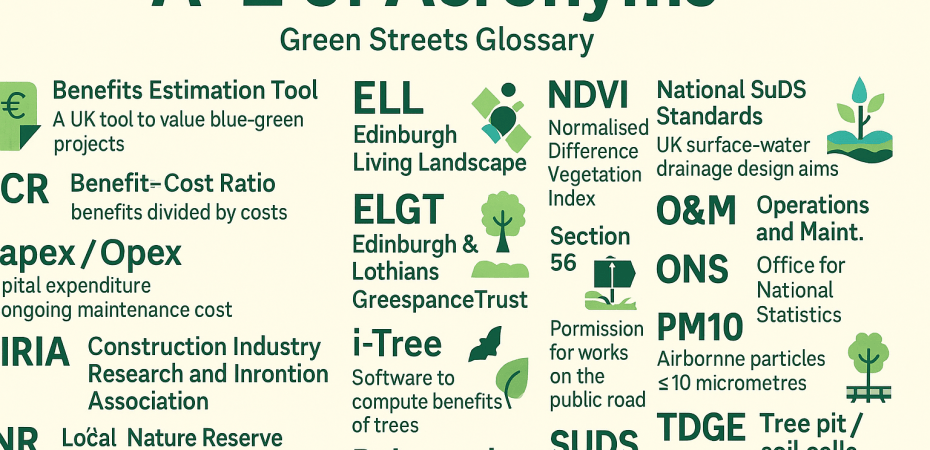
There are a lot of technical terms used in documents. Here are some of them explained.
- A8 / St John’s Road — the main road through Corstorphine (A-road on the GB network; see DfT road-traffic site for context). (roadtraffic.dft.gov.uk)
- ADT (Average Daily Traffic) — typical number of vehicles using a road each day (DfT uses the closely related AADF measure). (GOV.UK)
- BeST (Benefits Estimation Tool) — UK tool from CIRIA that puts £ values on the multiple benefits of blue-green projects. (susdrain.org)
- BCR (Benefit–Cost Ratio) — benefits divided by costs; a BCR of 2 means £2 benefit for every £1 spent (explained in HM Treasury’s Green Book). (GOV.UK)
- Capex / Opex — up-front build cost vs ongoing maintenance cost (see Green Book overview for how appraisals treat costs/benefits). (GOV.UK)
- CIRIA (Construction Industry Research and Information Association) — UK body behind the SuDS Manual and BeST. (ciria.org)
- “Cut-and-collect” — mowing a meadow and removing the cuttings to keep soils lean (helps flowers; can cut costs); Plantlife’s verge guide has the details. (Plantlife)
- Defra (Department for Environment, Food & Rural Affairs) — UK government department for environment policy/evidence. (GOV.UK)
- EA (Environment Agency) — publishes the standard appraisal guidance for flood/coastal projects (FCERM). (GOV.UK)
- ELL (Edinburgh Living Landscape) — partnership delivering nature-friendly management and projects across the city (Council + partners). (The City of Edinburgh Council)
- ELGT (Edinburgh & Lothians Greenspace Trust) — local charity delivering greenspace projects. (elgt.org.uk)
- ENN (Edinburgh Nature Network) — strategy and mapped opportunities for connecting Edinburgh’s green/blue spaces. (Thriving Greenspaces)
- i-Tree — internationally used tools to calculate/monetise the annual benefits of trees. (itreetools.org)
- LNR (Local Nature Reserve) — local designation for protected sites for people and wildlife in Scotland (NatureScot explainer). (NatureScot)
- National SuDS Standards — UK non-statutory standards for designing, operating and maintaining surface-water drainage. (GOV.UK)
- NDVI (Normalised Difference Vegetation Index) — satellite “greenness” score used in greenspace/health studies. (NASA Earthdata)
- O&M (Operations and Maintenance) — the routine work to look after assets (e.g., mowing, weeding, litter-picking); handled in appraisals alongside capex in the Green Book approach. (GOV.UK)
- ONS (Office for National Statistics) — the UK’s national statistics institute. (Office for National Statistics)
- PM10 — airborne particles ≤10 micrometres; a standard UK air-quality metric. (GOV.UK)
- RBGE (Royal Botanic Garden Edinburgh) — Scotland’s national botanic garden and research centre. (Royal Botanic Garden Edinburgh)
- Rain-garden — a shallow planted basin beside a kerb/path that takes runoff and lets it soak in, reducing puddles and pollution (CIRIA component page). (susdrain.org)
- Section 56 (Roads (Scotland) Act 1984) — permission needed for anything placed on/in the public road (e.g., planters, tree pits). (Legislation.gov.uk)
- SuDS (Sustainable Drainage Systems) — stainable Drainage Systems: features that manage rain where it falls—
- Permeable paving (water goes through),
- Rain-gardens (shallow planted basins that hold and soak water),
- Swales (shallow grassy channels),
- Basins/ponds (temporary storage).
Goal: reduce puddles/flooding and clean the run off before it reaches drains/streams.(SuDS Manual C753 + update). (ciria.org)
- TDAG (Trees and Design Action Group) — practical guidance on fitting trees into streets/places (see guides + “Trees in Hard Landscapes”). (Trees and Design Action Group)
- Tree pit / soil cells / root directors — underground structures that give street-tree roots space and protect utilities/surfaces (TDAG/industry guides). (Trees and Design Action Group)
 Corstorphine in Bloom