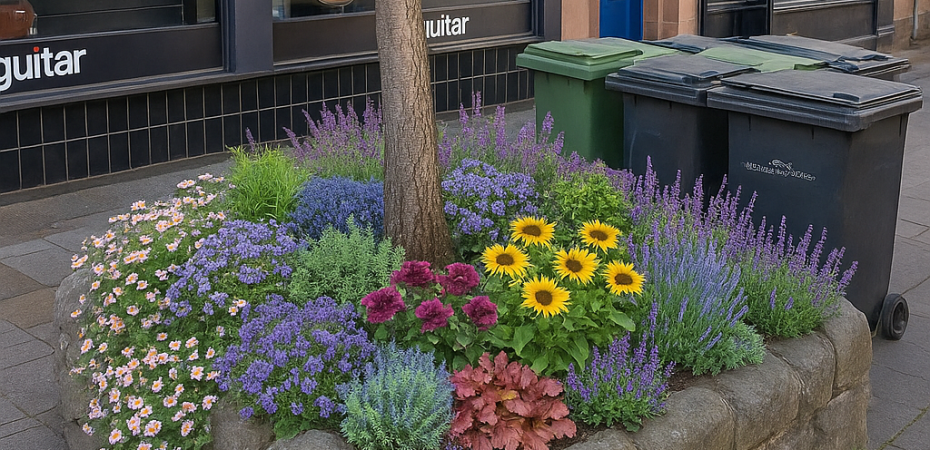
The council nursery have advised that, because of the limited soil depth and the dryness caused by the tree, planting in these stone planters needs to be simple, tough and realistic.
This page sets out a planting approach for a 125 cm x 125 cm stone planter with a tree in the middle. That means the planted space is smaller than it first appears, because a clear ring needs to be left around the trunk.
The best approach is not to overfill the planter. A restrained mix of drought-tolerant plants around the outer part of the bed will usually work better than trying to pack the whole planter densely.
What kind of planting suits this planter?
These planters are best treated as:
- dry or fairly dry
- sunny to lightly shaded
- shallow and rooty
- best planted around the outside rather than right up to the trunk
If the tree canopy is very dense, or the roots are especially strong, use fewer plants and concentrate them toward the outer edge.
Quick tree check
The exact tree matters less than the growing conditions.
- Thorns present → likely hawthorn
- Cherry-type bark, serrated leaves → likely ornamental cherry
- Glossy oval leaves, small pear-like fruit → likely ornamental pear
Whatever the tree is, the safest assumption is that the planter will be drier and more root-filled than an ordinary flower bed.
Prep
- Hand-weed and remove litter.
- Expose the root flare and do not bury the trunk.
- Gently loosen only the top few centimetres of soil.
- Do not dig deeply near the trunk.
- Water once before planting so the soil is workable.
Soil refresh
For a planter of this size, top-dress and improve the upper layer rather than trying to re-make the whole bed.
Use roughly:
- 25 litres peat-free compost
- 25 litres loam-based compost
- 10 litres grit or sharp sand
- slow-release fertiliser at label rate
Mix this into the top layer only.
Finish with a mulch layer, but keep a clear space around the trunk.
Planting rules
- Keep a 20–25 cm clear mulch ring around the trunk
- Plant mainly in the outer half of the planter
- Use fewer, tougher plants
- Let the planting grow in over time rather than trying to fill every gap at once
Recommended planting palette
Best core plants for this planter
These are the strongest choices for a small, dry, sunny stone planter:
- Mexican fleabane (Erigeron karvinskianus)
- Creeping thyme (Thymus spp.)
- Catmint (Nepeta ‘Walker’s Low’)
- Sedum / stonecrop (Hylotelephium)
- Lamb’s ear (Stachys byzantina)
- Perennial wallflower (Erysimum ‘Bowles’s Mauve’)
Use sparingly as feature plants
These are useful, but only use one of them as a stronger anchor plant:
- Lavender
- Santolina
- Euonymus fortunei ‘Emerald Gaiety’
Use only if the spot is slightly kinder
These are better on a slightly shadier or less harsh side of the planter, not in the driest central zone:
Bulbs
Bulbs can be tucked between the permanent plants in autumn.
Good options are:
- Crocus
- Dwarf tulips
- Alliums
- Daffodil ‘Tête-à-Tête’ (need moist soil)
How many plants to buy
For one 125 cm x 125 cm planter with a tree in the middle, a good guide is:
- 4–5 edge plants
- 3–4 filler plants
- 1 anchor plant
- 20–30 bulbs
That is enough for the planter to look cared for without becoming overcrowded.
Simple shopping list
A practical planting list for one planter would be:
- 2 creeping thyme
- 3 Mexican fleabane
- 2 Nepeta
- 1 sedum
- 1 lamb’s ear or 1 perennial wallflower
- 1 lavender or 1 santolina or 1 euonymus
- 24–30 bulbs
Optional:
- 1 campanula on a slightly kinder edge
- 1 heuchera only if there is a slightly shadier, less dry side
Layout in minutes
- Keep the 20–25 cm ring around the trunk clear
- Put the thyme and fleabane around the edge
- Place the fillers in small groups in the outer half of the planter
- Add one anchor plant only
- Tuck bulbs between the permanent plants
- Finish with mulch, but keep it away from the trunk
Watering
After planting:
- Water the whole planter well to settle it in
For the first 4–6 weeks:
- water regularly in dry weather
After that:
- water during dry spells
- expect the outer plants to cope better than anything placed near the trunk
Water slowly and keep water off the trunk.
When to plant
Best times:
- April to May
- September to October
Bulbs:
- September to November
Maintenance
Spring
- tidy winter damage
- top up mulch
- divide crowded plants if needed
Summer
- weed lightly
- deadhead where useful
- water in dry spells
Autumn
- plant bulbs
- replace any failures
- divide and replant if clumps are too large
All year
- keep mulch and soil away from the trunk
- remove litter
- do not let the planting become too dense
Final note
This is a small feature planter, not a large border.
The aim is to have a planting scheme that is:
- attractive
- realistic
- pollinator-friendly
- easy for volunteers to maintain
- tough enough to cope with dry conditions and tree roots
In practice, fewer plants, planted well, will usually do better than too many plants crowded together.
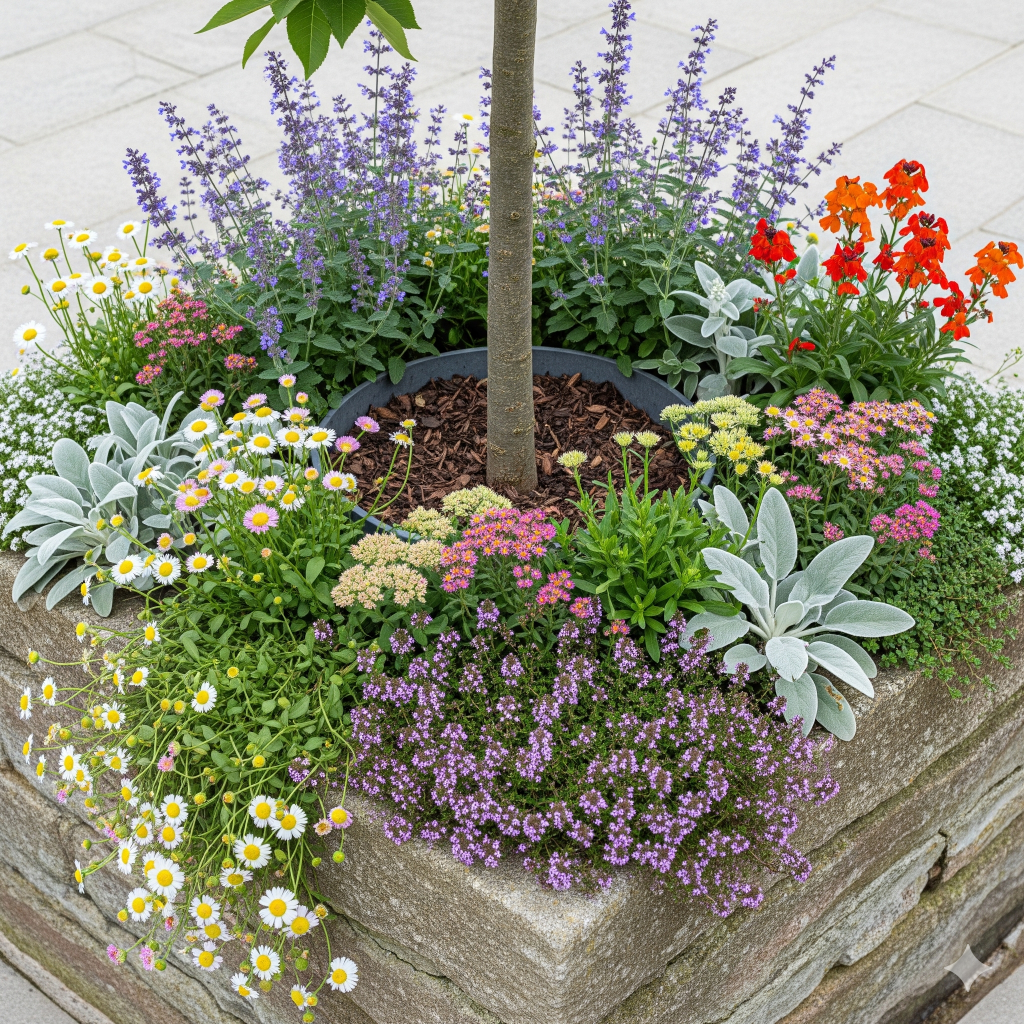
The planting scheme for the 125 cm x 125 cm stone planters includes a central tree with a clear mulch ring, surrounded by a mix of Mexican fleabane, creeping thyme, catmint, sedum, lamb’s ear, and perennial wallflower.
 Corstorphine in Bloom