
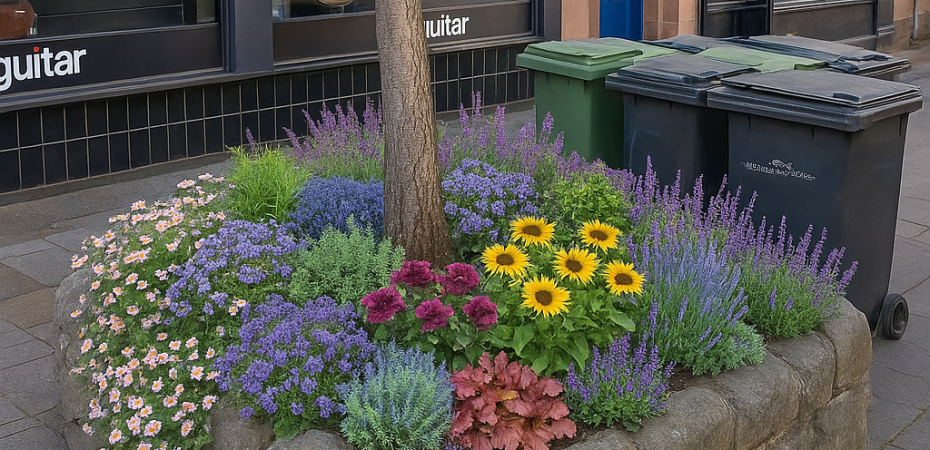
The council nursery have advised that due to soil depth and dryness any new planting will be quite restricted. The plants below have been suggested for that purpose.
Overview
- Perennials for colour and structure: Echinacea, Rudbeckia, Hosta, Sedum/Stonecrop, Campanula.
- Pollinator attractors: Lavender, Alliums, Salvias, Nepeta (catmint), Achillea (yarrow).
- Shrubs for year-round interest: Hebe, Dwarf conifers, Cotoneaster, Hydrangea.
- Seasonal bulbs: Crocus, Tulips, Snowdrops.
- Wildflower corners (native): Oxeye daisy, Cornflower, Red clover.
Compost & soil: Improve existing soil with peat-free compost or well-rotted organic matter; top up with local topsoil if needed. Mulch (bark or compost) to retain moisture and suppress weeds.
Seasonal timeline:
- Spring (Mar–Apr): Sow wildflowers; enjoy early bulbs.
- Summer (Jun–Aug): Perennials/shrubs provide height and colour; deadhead to prolong flowering.
- Autumn (Sep–Oct): Plant bulbs for next spring; divide overgrown perennials.
- Winter (Nov–Feb): Evergreen structure; refresh mulch to protect roots.
Action plan
1) Quick ID check for the tree (on site)
- Thorns present → Hawthorn (Crataegus).
- No thorns; finely serrated leaves, cherry-type bark → Ornamental cherry (Prunus).
- Glossy oval leaves; tiny hard “pears” in autumn → Ornamental pear (Pyrus calleryana).
(Whatever it is, the under-planting below still works.)
2) Prep (60–90 mins)
- Hand-weed and remove litter.
- Expose the root flare (don’t bury the trunk).
- Fork the top 5–8 cm gently to break crust; don’t dig deep near the trunk.
- Water once (10–15 L) so the soil is workable.
3) Soil refresh (per m²)
- Peat-free multi-purpose compost: 25 L
- Loam-based compost (John Innes No.3 or similar): 25 L
- Sharp grit/sand: 10 L
- Slow-release fertiliser (balanced 5-5-5): use label rate
Mix and work this into only the top 8–12 cm. - Finish with 5–7 cm bark mulch, kept 10 cm away from the trunk.
4) Planting palette (sunny, drought-tolerant, pollinator-friendly)
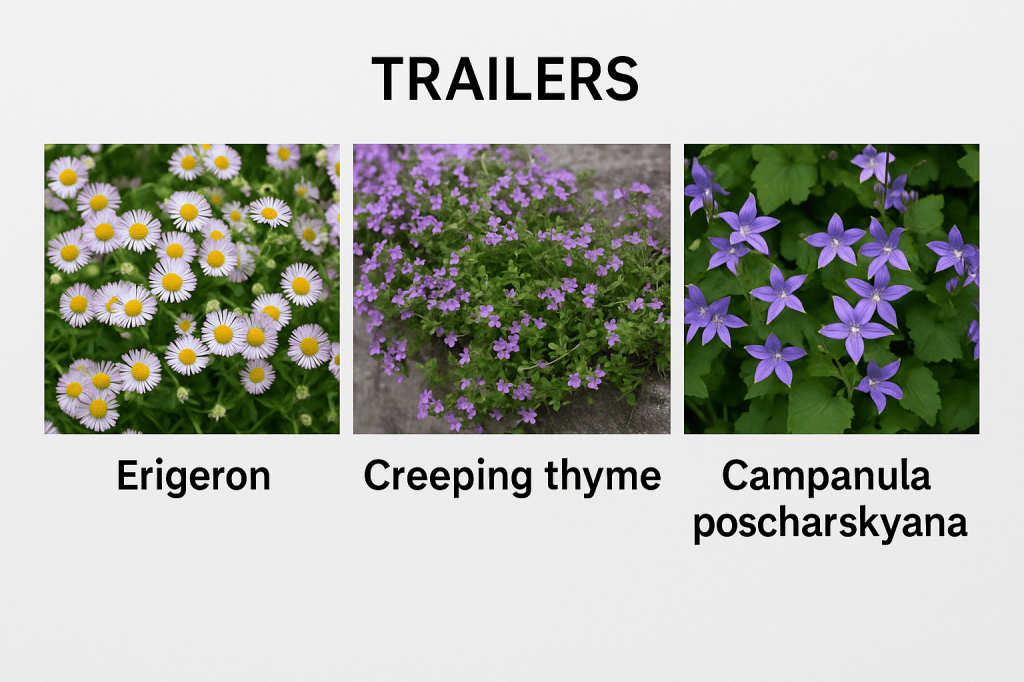
Edge (trail/soften stone), 25–30 cm spacing
- Mexican fleabane (Erigeron karvinskianus)– pictures & care (sun, drought-tolerant). RHS
- Creeping thyme (Thymus spp.) – species page + “How to grow thyme”. RHS+1
- Trailing bellflower (Campanula poscharskyana) – pictures & cultivation notes (great ground cover). RHS
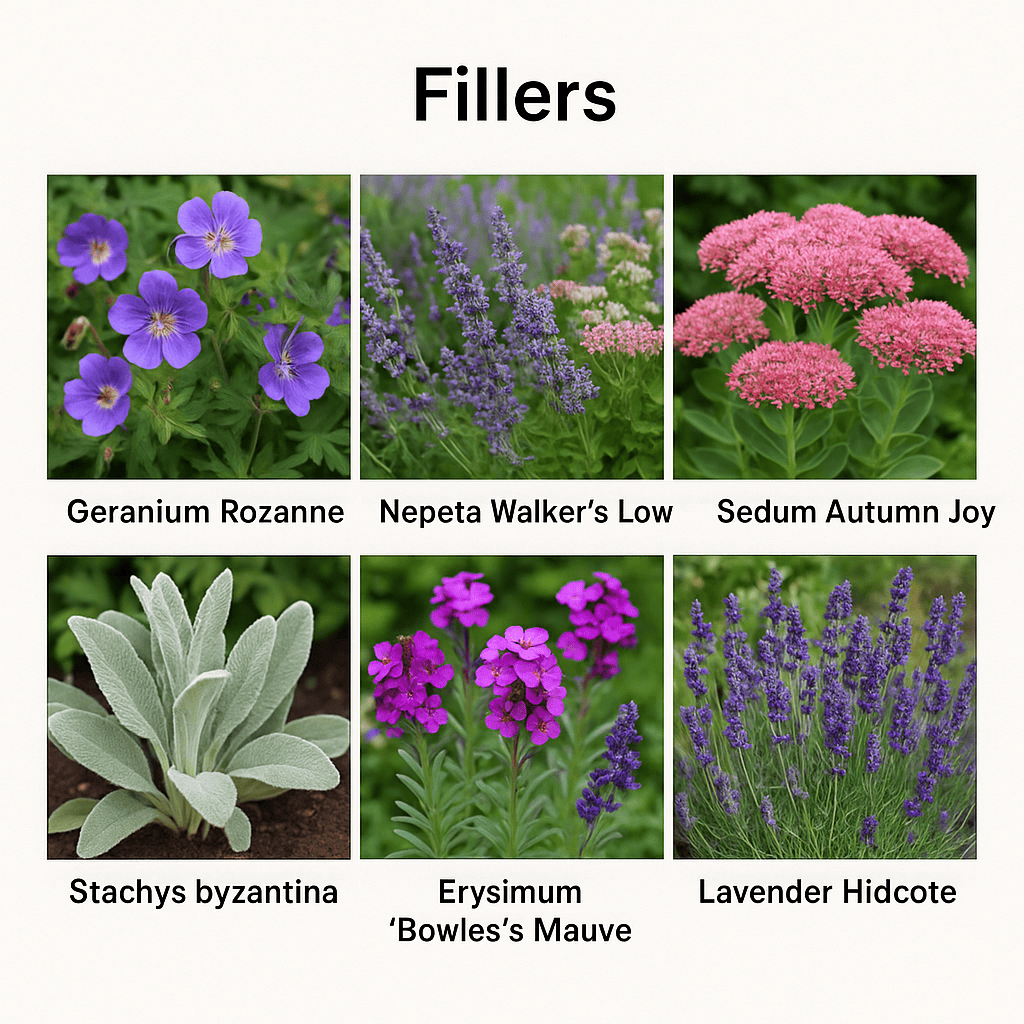
Fillers (35–40 cm spacing)
- Catmint (Nepeta racemosa ‘Walker’s Low’) – cultivar page + RHS Nepeta overview. RHS+1
- Sedum/stonecrop (Hylotelephium ‘Herbstfreude’/‘Autumn Joy’) – genus page + cultivar + growing guide. RHS+2RHS+2
- Lamb’s ear (Stachys byzantina) – species page + growing guide. RHS+1
- Perennial wallflower (Erysimum ‘Bowles’s Mauve’) – cultivar page + RHS note on perennial wallflowers. RHS+1
- English lavender ‘Hidcote’ (Lavandula angustifolia) – cultivar page + RHS lavender overview. RHS+1
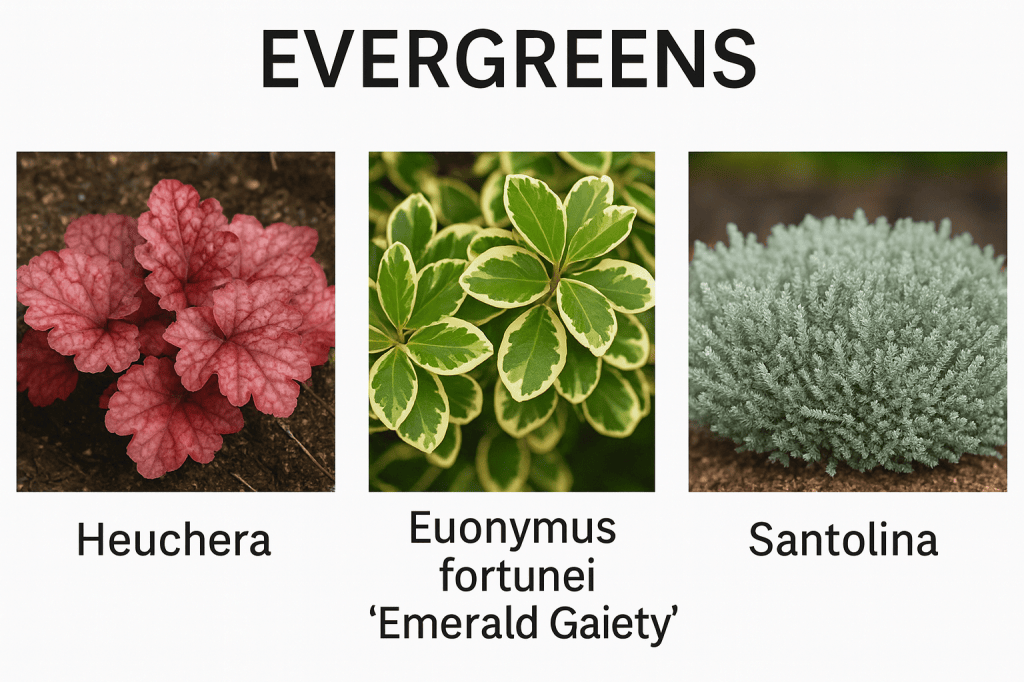
Evergreen dots
- Heuchera (coral bells) – RHS growing guide (lots of pictures across pages). RHS+1
- Spindle ‘Emerald Gaiety’ (Euonymus fortunei) – cultivar page. RHS
- Cotton lavender (Santolina chamaecyparissus) – species page (pruning + sun). RHS
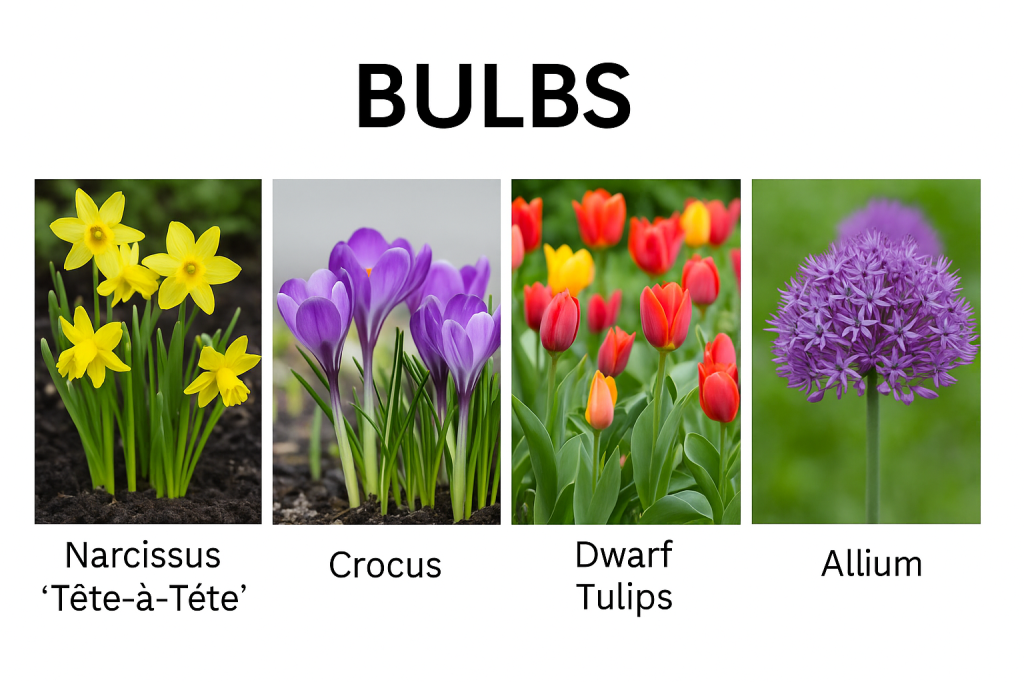
Bulbs (autumn)
- Crocus – RHS crocus hub & growing guide. RHS+1
- Dwarf tulips – RHS tulip guide + AGM dwarf selections. RHS+1
- Alliums (ornamental onions) – RHS guide + plant hub. RHS+1
How many plants to buy (rule of thumb)
- Per m²: 3–4 edge plants + 4–5 fillers + 1 evergreen “dot” + 20–30 bulbs.
(If your bed is ~2 m², double that.)
5) Layout in minutes
- Keep a 20–25 cm mulch ring clear round the trunk.
- Run the edge plants around the inside of the stone.
- Drop 5–8 clumps of fillers through the centre.
- Add 2–3 evergreens as winter anchors.
- Tuck bulbs between everything.
6) Watering (measurable, with a can)
- After planting: 20–30 L total to soak.
- Weeks 1–6: 10–15 L per m², 2–3×/week if dry.
- Thereafter (summer dry spells): 10 L per m² weekly (annuals may need twice).
Water slowly; keep water off the trunk.
7) When to do it / replacements
- Best planting windows: Sept–Oct or Apr–May.
- Bulbs: Sept–Nov.
- Perennials: no seasonal change-out; divide/refresh every 3–5 years.
- Mulch top-up: each spring (5 cm).
8) Maintenance cheat-sheet
- Mar/Apr: trim winter tat, feed, mulch, split crowded clumps.
- May–Aug: deadhead wallflower/lavender; shear Nepeta after first flush; monthly weed.
- Sept/Oct: plant/divide perennials; add bulbs.
- All year: keep mulch off trunk; remove litter.
9) Indicative budget (per m², UK high-street prices)
- Compost/loam/grit: £15–£22
- Bark mulch: £6–£10
- Plants (10–12 perennials incl. a few evergreens): £45–£70
- Bulbs (25–30): £8–£12
Total: ~£75–£110 per m² (can be halved via donations/wholesale).
10) Volunteer rota template
- Weeks 1–6 (establishment): Mon & Thu – “Water 1 can each side (≈10–15 L/m²), quick litter pick.”
- Summer dry spells: Sat – “1 can/m²”; Wed (optional) – “spot-water wilting plants.”
- Monthly: “15-min weed & deadhead.”
Example Flowers with Pictures

- Mexican fleabane (Erigeron karvinskianus)– pictures & care (sun, drought-tolerant). RHS
- Creeping thyme (Thymus spp.) – species page + “How to grow thyme”. RHS+1
- Trailing bellflower (Campanula poscharskyana) – pictures & cultivation notes (great ground cover). RHS

- Hardy geranium ‘Rozanne’ – cultivar page; also RHS feature on award-winning geraniums. RHS+1
- Catmint (Nepeta racemosa ‘Walker’s Low’) – cultivar page + RHS Nepeta overview. RHS+1
- Sedum/stonecrop (Hylotelephium ‘Herbstfreude’/‘Autumn Joy’) – genus page + cultivar + growing guide. RHS+2RHS+2
- Lamb’s ear (Stachys byzantina) – species page + growing guide. RHS+1
- Perennial wallflower (Erysimum ‘Bowles’s Mauve’) – cultivar page + RHS note on perennial wallflowers. RHS+1
- English lavender ‘Hidcote’ (Lavandula angustifolia) – cultivar page + RHS lavender overview. RHS+1

- Heuchera (coral bells) – RHS growing guide (lots of pictures across pages). RHS+1
- Spindle ‘Emerald Gaiety’ (Euonymus fortunei) – cultivar page. RHS
- Cotton lavender (Santolina chamaecyparissus) – species page (pruning + sun). RHS

