
Parts of the area are in the most deprived 20% of Scotland.
The Scottish Index of Multiple Deprivation (SIMD) shows that parts of Corstorphine and Clermiston face hidden deprivation, particularly around health, wellbeing and social isolation. Corstorphine in Bloom provides preventative, community-led action that directly addresses these pressures at very low cost to the public purse.
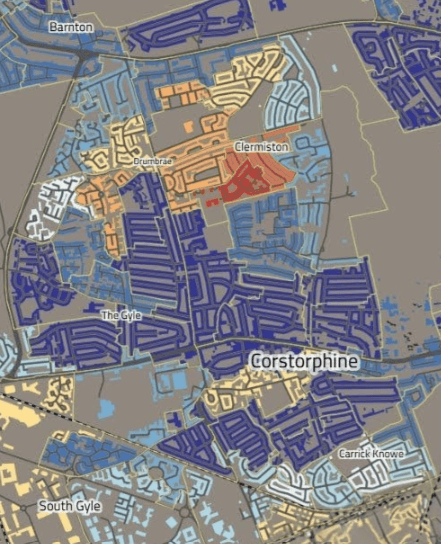
SIMD looks at 7 everyday aspects of life:
- Income (low household income)
- Employment (unemployment / insecure work)
- Health (illness, hospital admissions, mental health)
- Education (school attendance, qualifications)
- Access to services (GPs, shops, public transport)
- Crime
- Housing (overcrowding)
Corstorphine and Clermiston is not uniformly affluent – deprivation exists in pockets.
🧠 Health
Indicators like:
- DRUG / ALCOHOL, DEPRESSION, SMR (early death rates), Emergency admissions
These often cluster together and appear even where income deprivation is not extreme
👉 This strongly links to mental health, loneliness, and lifestyle factors, not just poverty.
How Corstorphine in Bloom can help
🌱 1. Mental health & wellbeing
Strong evidence shows that:
- Green spaces
- Gardening
- Volunteering
- Walking routes
reduce: - Depression
- Anxiety
- GP visits
👉 This directly links to the health indicators in SIMD (DEPRESSION, EMERG, SMR).
🤝 2. Social connection (huge but often invisible)
SIMD does not directly measure loneliness, but loneliness drives:
- Poor mental health
- Alcohol misuse
- Physical decline
Corstorphine in Bloom:
- Creates low-barrier ways to meet people
- Is especially important for:
- Older residents
- People not in work
- New residents
🚶 3. Access without cost
Your projects:
- Are free
- Are local
- Do not require transport, booking, or confidence
That is crucial in SIMD terms: Access barriers are often social and psychological, not just physical.
🎓 4. Informal learning & skills
Bloom activities build:
- Confidence
- Teamwork
- Practical skills
- Intergenerational contact
These contribute (indirectly but meaningfully) to:
- Education outcomes
- Employability
- Youth engagement
🏘️ 5. Pride, safety, and perception
Well-kept spaces:
- Reduce fear of crime
- Encourage people to spend time outside
- Improve how an area feels
That matters even where crime rates are not high.
 Corstorphine in Bloom