

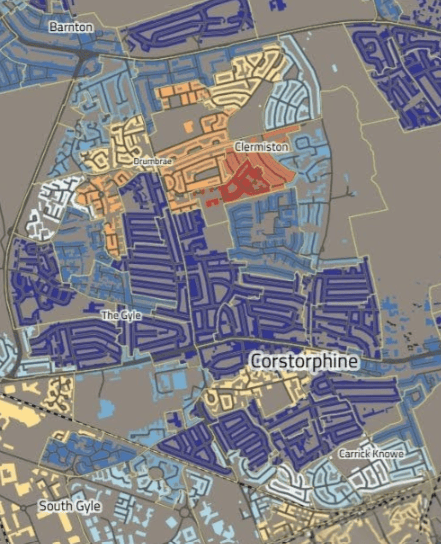
The data headings in the spreadsheet below are part of the Scottish Index of Multiple Deprivation (SIMD) 2020 data store. .SIMD is the Scottish Government’s official tool for identifying areas with high concentrations of deprivation across the country. It is a relative measure, meaning it shows if one area is more or less deprived than another. Here is a breakdown of the key headings and what they mean:
Overall SIMD Ranks
- Rank, Percentile, Vigintile, Decile, Quintile: These are based on the overall SIMD score, which combines the seven domains.
- Rank: Ranks the 6,976 small areas (Data Zones) in Scotland from 1 (most deprived) to 6,976 (least deprived).
- Percentile, Decile, Quintile, Vigintile: Group the overall rank into bands for easier analysis (e.g., Quintile 1 is the 20% most deprived areas, Quintile 5 is the 20% least deprived areas).
The Seven Domains of DeprivationThe data includes a rank for each of the following seven domains. For all domain ranks, Rank 1 is the most deprived in that specific area of life.
| Heading/Domain | What it Measures | Included Indicators |
|---|---|---|
| Income Domain Rank | The proportion of people living in the area who are considered income-deprived. | Based on the number of people claiming relevant benefits -Income Support Employment and Support Allowance, Job Seekers Allowance, Guaranteed Pension Credits Child and Working Tax Credits |
| Employment Domain Rank | The proportion of the working-age population who are employment-deprived. | People who are unemployed or economically inactive due to long-term sickness or disability. |
| Health Domain Rank | The area’s health outcomes, considering both physical and mental health. | Measures indicators covering drug and alcohol use, mortality, long-term health, depression, low birth weights, and emergency hospital stays. |
| Education Domain Rank | The deprivation level related to skills and training for both children and the general adult population. | School attendance, exam performance, the proportion of adults with no qualifications, and youth not in education, employment, or training (NEETs). |
| Access Domain Rank | The geographic barriers to accessing important services. | Measures travel times (by drive and public transport) to key services like a GP, Post Office, Primary School, and retail, as well as average broadband speeds. |
| Crime Domain Rank | The relative exposure of the local population to crime. | Based on the number of recorded crimes, including violent crimes, housebreaking, and vandalism. |
| Housing Domain Rank | Housing circumstances that cause a detrimental impact on health and/or quality of life. | Measures households classed as overcrowded and those living without central heating. |
Other Headings
- Total_population / Working_Age_population: The total and working-age population count for the Data Zone.
- income_rate / income_count: The rate and count of people who are income-deprived.
- employment_rate / employment_count: The rate and count of people who are employment-deprived.
- DEPRESS, is the rate of people claiming certain health-related benefits
- ALCOHOL,
- DRUG,
- EMERG: (likely Emergency Hospital Admissions
- LBWT is the rate of low birth weight).
Specifically, the “not_participating” figure in the SIMD represents the proportion of 16-19 year olds in a Data Zone who are not participating in education, employment, or training.It’s used as an indicator of a lack of opportunities and skills in the local population.
 Corstorphine in Bloom