
This is the detailed plan for the overall plan below. It will be updated as we progress.
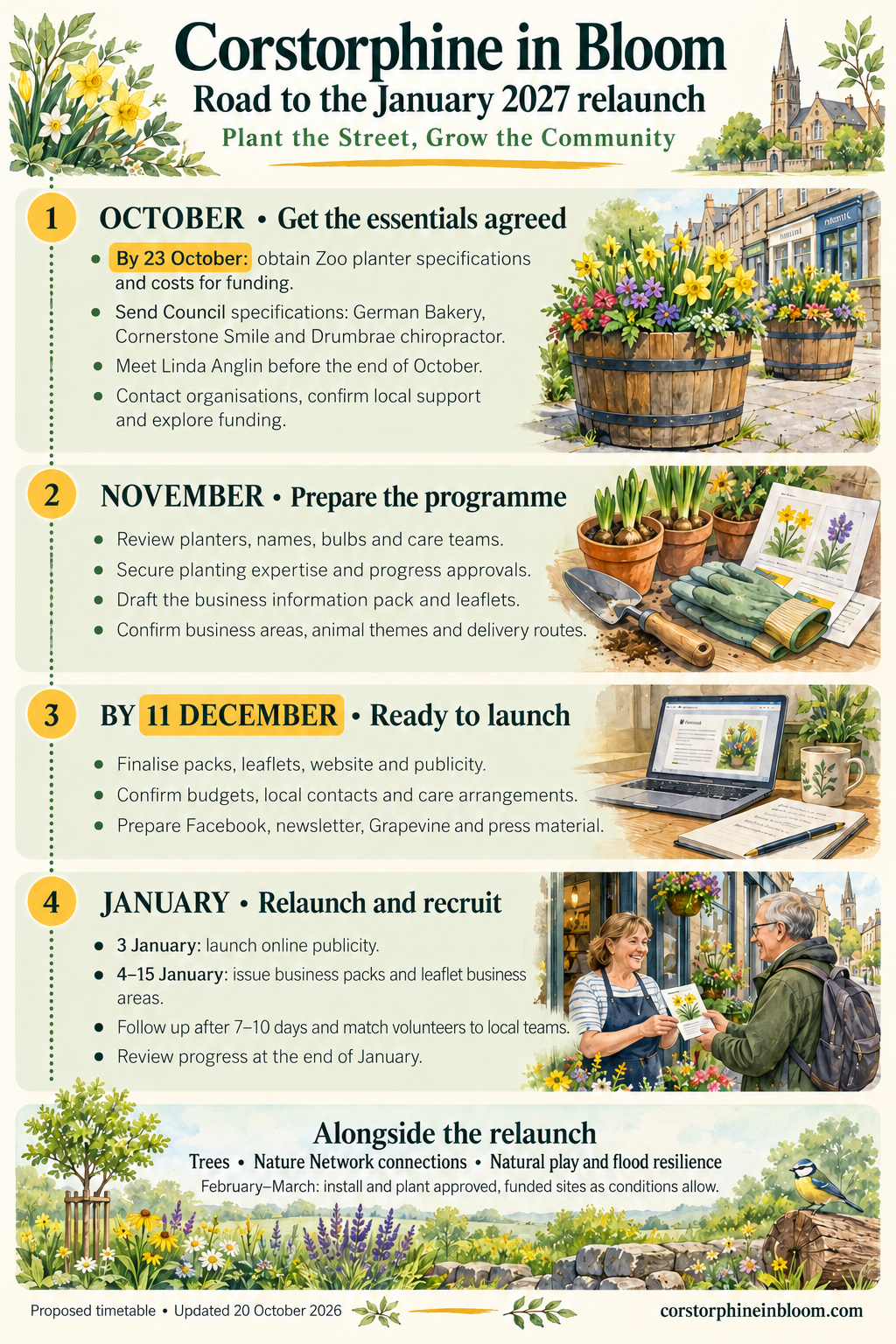
Executive summary
The new Council process for approving planters gives Corstorphine in Bloom an opportunity to turn business and public interest into a manageable programme of improvements. The priority before January is to organise the sites, people, planting advice and funding needed to deliver what the relaunch promises.
Launch the publicity on 3 January 2027, followed by direct business contact and volunteer recruitment through January. Use the autumn to resolve outstanding planter enquiries and establish local care teams. Plan installations and planting around individual approvals, available funds and suitable seasonal conditions.
The website already presents Bloom as a neighbourhood effort involving businesses, residents and community partners. It reports 15 barrels rolled out, three planters replanted, 56+ interested businesses and 179+ volunteers and supporters, dated 6 October 2026. These figures provide a useful starting point, but should be checked before reuse in January publicity. [1]
Run two programmes alongside one another: a practical planter programme ready for recruitment in January, and longer-term work on trees, habitat connections and the St Margaret’s Park natural play and drainage proposal. The latter should have clear next steps by January, without making the relaunch depend on their completion.
Five priorities before Christmas
- Confirm the approval route and create one register of existing and proposed planters, with a named contact and care arrangements for each.
- Obtain the Zoo specification by 22 October, ahead of the 23 October funding application; submit the three urgent business site specifications to the Council.
- Recruit planting expertise, request bulbs promptly and agree affordable planting and maintenance plans.
- Prepare for the meeting with Linda Anglin before the end of October; agree next steps on trees, nature and drainage, and contact local organisations.
- Prepare the business pack, leaflets and publicity by 11 December for distribution in January.
Delivery approach: allocate a lead and a backup for each work area, with short written updates rather than additional standing meetings. All responsibilities and dates below are proposed for agreement; external partners have not yet committed.
1. Planters and practical preparation
Proposed lead: planter coordinator, supported by local hosts and a planting adviser. October actions should begin immediately; prioritise the Zoo funding deadline and three immediate Council submissions.
Confirm the Council process | by 30 October
Immediately send the German Bakery, Cornerstone Smile and Drumbrae chiropractor specifications to the Council; proposed target 20 October. Check exact names and addresses. Record the officer/contact, required information and approval conditions. Use a repeatable site sheet with location, photographs, dimensions, proposed position and care arrangements. Distinguish a process being available from an individual site being approved.
Update 22 OCT – all sites surveyed and packs prepared. See https://corstorphineinbloom.com/tag/permission-sought-from-the-council/
Deliverable: One reusable application pack and a status for every proposed site: enquiry, submitted, approved or installed.
Zoo Planters and Drumbrae funding | specification by 22 October
Ask the Zoo for dimensions, materials, weight, drainage, capacity, cost, delivery/installation requirements and any artwork or interpretation arrangements. Ask the relevant Drumbrae group whether it wants to lead a funding bid, for which sites, and by what deadline. Confirm the applicant and Drumbrae’s involvement immediately. Chase missing details by 20 October; obtain the specification before 23 October for the funding application. [Original item 1]
Deliverable: Specification and quote by 22 October; costed funding application ready for 23 October. Confirm the funder’s exact submission cut-off.
Update 22 Oct – Zoo emailed and contacted. We do not have a partner willing to hold funding at this point. Main thing is to get zoo on board. Phoned today and left a message.
Planting expertise | adviser agreed by 6 November
Seek an experienced volunteer, horticultural contact or partner able to advise on plant choice, container depth, exposure, seasonal interest and maintenance. Ask for a small selection of planting schemes and costings that local teams can use. (Original item 2)
Deliverable: A named adviser and simple planting/care sheets by 20 November.
Review planters, names and bulbs | audit by 6 November
Visit existing and proposed sites. Record location/name, condition, dimensions, permission, business or sponsor, local carers, water access and work needed. Check labels and credits. Ask for bulbs now, with quantities and suitable locations guided by the adviser; arrange planting within the appropriate autumn window. (Original item 10)
Deliverable: An updated register, repair/replanting list, bulb request and planting dates.
Shirley’s planter | contact by 23 October
Confirm which planter is involved, its intended position, current status, what Shirley needs from Bloom and who will look after it. Agree the next action and date. (Original item 11)
Deliverable: A complete site entry with responsibility, approval status and next step.
Update October 22 – emailed person repeatedly with no reply. May pass on to others if no reply to the latest email.
Library and bus stop planters: Aileen | contact by 23 October
Confirm the exact library and bus stop locations, barrel availability, approvals, delivery arrangements, planting and watering contacts. Reconcile these with the Council’s written approvals before setting installation dates. (Original item 12)
Deliverable: A short delivery plan for each location, including any remaining dependencies.
Update October 22 – emailed person today
2. Trees, nature and flood resilience
Proposed lead: nature coordinator, with interested volunteers and the relevant Council officers. Agree realistic next steps by January; delivery dates depend on technical advice and permissions.
The website’s climate and nature programme includes pollinator habitats, trees, connected green spaces and a natural play/drainage proposal at St Margaret’s Park. These provide a coherent direction for this work. [2] The Council’s Nature Network aims to connect parks, woodlands, waterways and other green spaces. [3]
Ask the canopy officer about trees | contact by 23 October
Ask how a community group can propose tree planting in Corstorphine: who assesses sites, what information is needed, who approves and installs trees, and what funding and aftercare arrangements apply. Ask for advice on locations with little canopy and on the scope for shade, habitat and rainwater benefits. (Original item 3)
Deliverable: Written route for progressing trees by 13 November, followed by a small shortlist of potential sites for officer assessment.
Update October 22 – emailed person today
Invite Michael into the tree work | contact by 23 October
Ask whether Michael would like to participate and what role suits him: identifying sites, local knowledge, liaison, planting or aftercare. Share the officer’s advice when available and agree a manageable task. (Original item 4)
Deliverable: A confirmed role or a recorded decision not to participate; avoid assuming that an invitation creates a commitment.
Update October 22 – emailed person today
Connect the green spaces | initial map by 27 November
Review the Nature Network opportunity maps and discuss local priorities with the Council’s biodiversity/Nature Network team. Map existing planting, parks, gardens, school grounds and potential links. Select two or three practical gaps for further investigation, checking ownership and long-term care. (Original item 5)
Deliverable: A simple opportunity map and ranked shortlist, with one achievable pilot for 2027. Ask how Bloom’s work can be recorded in the Network’s action log. [4]
Potential pilot types include a perennial bed, a suitable verge or a linked cluster of wildlife-friendly planting. Treat these as options for assessment. A walking trail and a functioning habitat connection are different outcomes; seek ecological advice on the latter.
Emma: natural play and flood mitigation | contact by 23 October
Ask for the current status of the St Margaret’s Park proposal, the next decision, required surveys/design, responsible Council team, funding route and the contribution expected from Friends of St Margaret’s Park and Bloom. Ask whether a site discussion would resolve outstanding questions. (Original item 6)
Deliverable: An agreed next-step note by 13 November, with responsible parties and a realistic timetable.
Keep this as a partner-led project with its own technical design and approvals. Describe it in January publicity according to its confirmed stage: proposal, design, funded or scheduled. Do not announce construction or a quantified flood benefit before these are established.
Update October 22 – The area may cost £20k. The first step is to get a proper design, and before that first step we need to agree the responsibilities of the council in terms of maintenance. After we have a design, we will be in a position to apply for funding. Will enquire with the council.
3. Funding, partners and responsibilities
TCV Chestnut Fund | enquiry by 30 October
Contact TCV’s Community Network team at local-groups@tcv.org.uk. Confirm membership and eligibility, explain the group’s actual operating history and constitution date, disclose existing funds and restrictions, and ask which costs could qualify. Then prepare an application if appropriate. (Original item 9)
Deliverable: Eligibility response, costed request and submission date by 13 November; record any decision timetable.
TCV currently lists start-up grants of up to £200 for first-year groups and support grants of up to £500 for tools, equipment and training. Membership is required and grants are described as a last resort. Recent constitution alone should not be assumed to establish first-year eligibility. Do not count an award as income until confirmed. [5]
Bruce and the Community Council | contact by 30 October
Explain the new planter approval route, the January relaunch and the proposed work on trees and connected green spaces. Share a concise plan and ask for local priorities, help publicising opportunities and a continuing contact. Propose a short written progress report for meetings. (Original item 8)
Deliverable: An agreed liaison arrangement and any useful introductions or feedback by 13 November.
Budget and purchasing | urgent bid by 23 October
Complete the Zoo-related bid budget by 22 October; prepare the wider programme budget by 13 November. List costs separately for containers/delivery, compost and planting, tools, labels/publicity and ongoing care. Record quotes, available funds, restrictions, donations in kind and the unfunded balance. Check remaining commitments against any existing grant before assigning money to new work. Identify the authorised payment route and who can approve spending.
Prepare a funded minimum programme and a separate expansion list. If funding or a bid is delayed, January recruitment can still proceed around existing planters and confirmed sites.
Update October 22 – waiting on zoo.
Keep management light
- Allocate planter, nature, funding and publicity responsibilities across willing committee members or volunteers. One person may cover more than one area, but agree a backup.
- Use one action register: action, lead, next step, due date, status, dependency and cost. Keep personal contact details separate from the public location map.
- Ask leads for a brief fortnightly email update through December. Escalate only decisions, overdue replies and blocked actions; follow up unanswered enquiries after 7–10 days.
- For each new planter, confirm written permission, sufficient funds, suitable planting and an agreed watering/maintenance arrangement before installation.
Agree by 30 October
Confirm the delivery leads, the January launch scope, the minimum budget and which sites form the first manageable group. Clarify the Drumbrae organisation, Shirley’s planter and the exact library/bus stop locations while making the initial enquiries.
4. January relaunch and delivery timetable
Proposed lead: publicity coordinator, with local business and volunteer contacts. Covers original item 7; all other numbered items are incorporated on the preceding pages.
Publicity preparation | complete by 11 December
Use the existing “Plant the Street, Grow the Community” identity. Lead with the new opportunity to bring more planters into use and invite practical help. Prepare separate messages for businesses (host, sponsor or help care for a planter) and residents (join a nearby care team, offer gardening knowledge or help occasionally).
Prepare a website update, newsletter, Facebook posts, a short Grapevine article, a printable poster and a brief press note with good photographs. Ask Grapevine about its January deadline now. Offer the press a photograph opportunity once a site, participants and date are confirmed.
Refresh the public location map and progress figures. Check the volunteer and business links, forms and mobile display, including links currently using the underlying WordPress address. Confirm who receives enquiries and aim to respond within five working days. Advertise only communication channels that are actually ready to use.
Milestones
| When | Outcome |
| 16–30 October | Submit three site specifications; secure Zoo details by 22 October for the funding bid; meet Linda; start partner outreach. |
| November | Draft business packs and leaflets; recruit organisations; progress approvals, planting advice and nature actions. |
| 1–11 December | Finalise business packs, leaflet routes and publicity; confirm funded sites and care teams; arrange the January welcome activity. |
| 3 January 2027 | Publish the New Year announcement on the website and Facebook; invite businesses and residents to register interest. |
| 4–15 January | Issue business packs and leaflet business areas; send the newsletter; pursue press coverage; match volunteers to local teams. |
| 16–31 January | Follow up business visits after 7–10 days; hold a welcome activity; confirm roles and work dates; review recruitment. |
| February–March | Install and plant approved, funded sites as conditions allow; progress the nature pilot; publish a short progress update. |
Review at the end of January
Report new enquiries, volunteers matched, local teams established, applications submitted/approved, sites funded and any installations completed. Every site selected for delivery should have a named contact and care arrangement. Set numeric expansion targets after the November audit, so they match available people and funds.
Sources reviewed on 16 October 2026
[1] corstorphineinbloom.com/ — homepage and progress figures.
[2] corstorphineinbloom.com/climate-nature-action/ — existing ambitions and partner projects.
[3] edinburgh.gov.uk/parks-open-spaces/programmes-initiatives-parks-open-spaces
[4] thrivinggreenspaces.scot/homepage/15/edinburgh-nature-network — maps and action log.
[5] tcv.org.uk/tcv-community-network-membership/chestnut-fund/ — current grant information.
5. Immediate action plan
The work plan sets the direction. This action list is for weekly use: assign an owner, record the actual completion date and carry forward any unresolved action. Owners below are proposed and must be agreed. The Linda meeting and Zoo deadline take priority.
A1 Secure the Zoo specification
Proposed owner: Zoo liaison / funding lead | Due: 22 October, before 23 October
Request full specification, quote, delivery and installation costs now. Confirm what the funding application needs and the funder’s cut-off. Chase by 20 October. Ask Drumbrae immediately whether it will apply and who will sign off the bid.
Complete when: The applicant has the specification and costs in time to submit the application. If delayed, ask the funder whether an estimate is acceptable; do not assume it is.
A2 Submit three business sites to the Council
Proposed owner: Andrew / planter lead | Due: 20 October proposed target
Send specifications for the German Bakery, Cornerstone Smile and the chiropractor at Drumbrae. Use one covering email and a clearly labelled attachment for each site: address, photograph, dimensions, position plan, pedestrian clearance and care contact. Confirm business names and addresses from existing records.
Complete when: The Council acknowledges all three sites and any missing information is logged against each. Track each approval separately.
A3 Prepare for Linda Anglin
Proposed owner: Andrew / Council liaison | Due: Meeting before 31 October; briefing two working days beforehand
Confirm the meeting date. Send a one-page briefing covering the new approval process, the three submissions, January relaunch, Zoo funding, and the help needed on trees, Nature Network links and natural play/drainage. Attach a simple map and list of decisions sought.
Complete when: The meeting identifies the Council contact for each work area, the next decisions and dates. Circulate a short action note within two working days.
A4 Start organisation outreach
Proposed owner: Partner liaison | Due: Contact list by 23 October; first invitations by 30 October
Recontact existing supporting organisations first, then approach groups in business areas with no local team. Offer one specific role and a short discussion, using the approach on page 7.
Complete when: Each priority organisation has a contact, an invitation, response and follow-up date; record agreed contributions rather than expressions of interest alone.
A5 Prepare business pack and leaflet routes
Proposed owner: Publicity lead / area contacts | Due: Final by 11 December; issue 4–15 January
Confirm the business-area and animal list; prepare the pack and an area-specific leaflet. Agree printing quantities and who will cover each shopping area. Deliver packs and leaflets during 4–15 January; follow up within 7–10 days.
Complete when: Materials ready by Christmas; delivery and follow-up recorded in January.
6. Organisations and business area outreach
Contact organisations before the public relaunch
Invite organisations into practical roles now, so January has local support already in place. Begin with existing partners, then fill gaps around the animal-themed shopping areas. Suggested groups include park Friends groups, the Community Council, libraries, the community centre, schools and parent councils, youth groups, churches, residents’ groups and gardening groups. These are categories to approach, not confirmed participants.
- Adopt or help maintain a planter, with a named contact and enough people to share the work.
- Support a business area by recruiting nearby volunteers, distributing leaflets or hosting a short introduction.
- Offer plant expertise, plants, bulbs, water, tools or an appropriate funding application.
- Help with tree ideas, wildlife recording, school activities or promotion of the future trail.
Send a short tailored invitation explaining what is now possible, what is needed locally and one suggested contribution. Ask for a response within two weeks and offer a brief call. Record the outcome by organisation and area. Avoid asking every group to join a committee or take on a large commitment.
Leaflet the animal themed business areas
The original project overview identifies eleven shopping areas and five parks, with animals intended to be associated with the sixteen areas. Use that structure for outreach. Confirm the existing area–animal allocations and any Zoo agreement before printing; do not create new allocations by assumption. [6]
Create a route sheet for each business area: boundary/map, proposed animal, shops to visit, nearby organisations, local contact, delivery date, responses and next visit. Include businesses that cannot host a planter but may offer sponsorship, water, publicity or occasional help.
The leaflet should explain the local area’s part in the trail, the new planter opportunity and how a business can take part. Include a short web address and QR code linking to the business pack, plus a direct contact. If the animal is not confirmed, describe the proposed theme clearly. Deliver in January with a brief face-to-face introduction where possible; follow up after 7–10 days.
Business information pack
Prepare a concise two- or three-page pack with a reusable site information form. Draft during November using the outcome of the Linda meeting; finalise by 11 December. Issue in January, with business visits and leafleting proposed for 4–15 January.
- What Bloom is doing: local benefits, the January relaunch and how the proposed animal trail fits in.
- Ways to participate: host, sponsor, provide water or materials, share care, or help promote the area.
- How a site progresses: expression of interest, site details, individual Council approval, funding, installation and ongoing care.
- Who does what: business, Bloom, volunteers and Council; confirm costs, permissions, insurance arrangements and responsibility rather than implying they are automatically covered.
- Practical details: planter options and example costs once confirmed, planting advice, watering, holiday cover and reporting problems.
- How to respond: named contact and form for business name, address, preferred role, proposed site, water access and permission to follow up.
Track outreach separately from installation: businesses visited, packs sent, organisations contacted, offers received, local carers confirmed and applications progressed. This shows where follow-up is needed during the January campaign.
[6] corstorphineinbloom.com/overview-of-corstorphine-in-bloom-project/ — original shopping-area, park and animal-theme structure, reviewed 16 October 2026.

